Cost
The AI subscription bill is getting absurd
Nobody signed up for a $50 monthly AI bill. It arrived one $12 subscription at a time, each of which was obviously worth it on the day you clicked it.
Where the money actually goes
The typical stack in 2026 looks something like this:
- A main assistant. The flagship chat product. Around $20/month is the standard individual tier across the major providers.
- A writing or grammar tool. Usually $10–$15/month.
- A transcription or meeting-notes tool. Another $10–$20/month.
- Something niche. An image tool, a study tool, a summarizer app that charges monthly for what is functionally one API call.
Any two of those is roughly $30–$40 a month. Three is $50. Call it $45 as a middle case: that's $540 a year and $1,620 over three years, for software that is largely wrapping the same handful of models.
The part that makes it feel worse
Two structural things about this pricing model are genuinely annoying, separate from the total.
You pay the same whether you use it four times or four hundred. Subscriptions are priced for the heavy user and sold to everyone. If you ask an AI to rewrite an email twice a week, you're paying the same monthly rate as someone running it eight hours a day.
You never stop paying for the thing you already got. Rewrite a paragraph in March, and you're still paying for that capability in November. With a perpetual license you'd own the tool. With a subscription, stopping means the tool disappears, so the price is effectively permanent.
When a subscription genuinely is the right call
To be fair about it, because sometimes it obviously is:
- You need the frontier model. Hard reasoning, long documents, complex code. The biggest cloud models are meaningfully better at these and they cost real money to run. Paying for that is rational.
- You need current information. Anything requiring live web access has to reach the internet by definition.
- It's your job. If AI is in your daily workflow, $20/month against your working time isn't a serious expense.
The problem isn't that subscriptions exist. It's that most people's actual usage doesn't resemble any of the three cases above.
What most people actually ask AI to do
Look honestly at your own history and the pattern is usually mundane:
- Rewrite this so it sounds more polite / shorter / less awkward.
- Summarize this long thing.
- Draft a reply to this message.
- Give me ten ideas for X.
- Explain this concept simply.
- Turn these notes into a study set or a checklist.
None of those need a frontier model, and none of them need the internet. They're language tasks on text you already have. That's precisely what a phone-sized on-device model handles well — see our honest capability map for where the line falls.
The alternative math
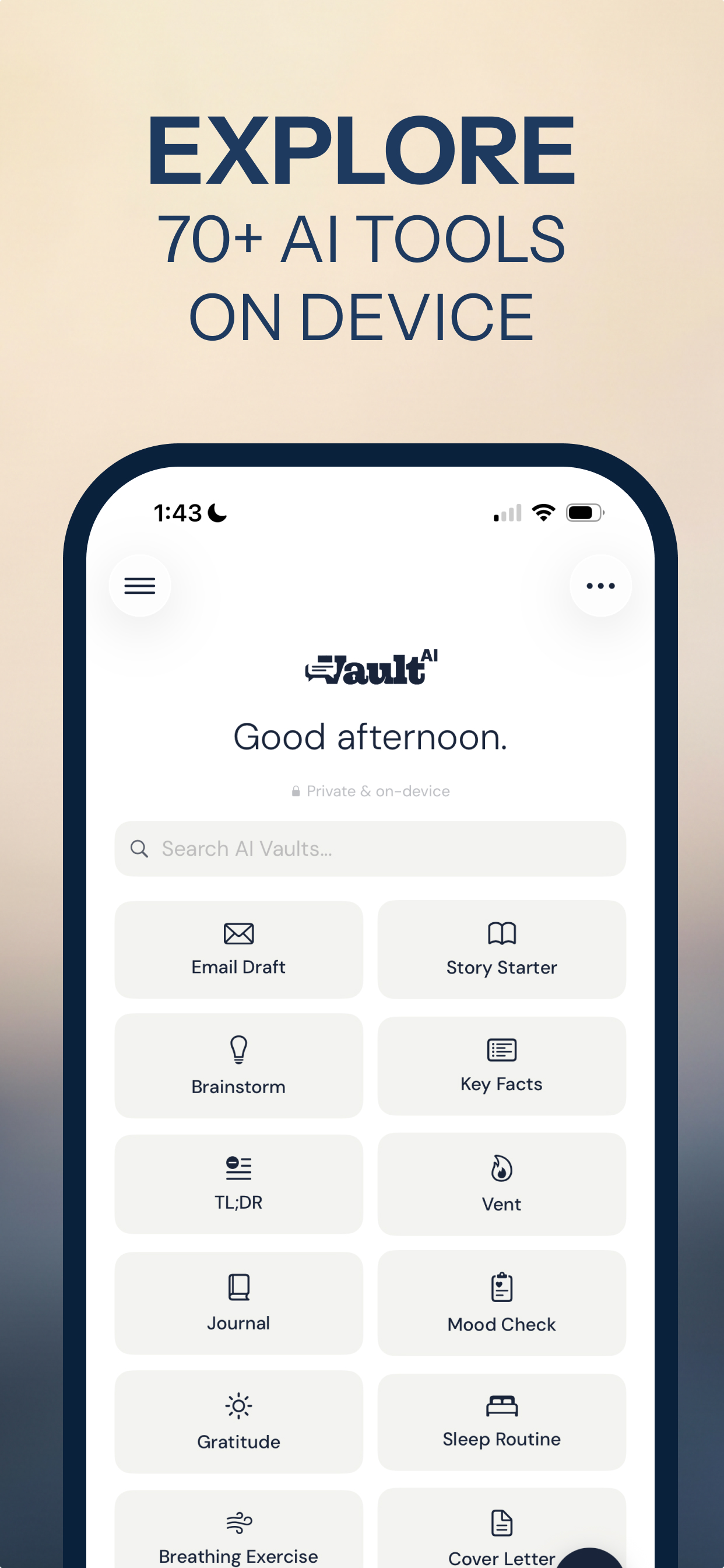
Your iPhone already contains a capable language model. It's already paid for. The only thing missing is software that puts a real interface on it — which is what Vault AI is: free to download, with a $2.99 one-time unlock. No account, no monthly charge, and it works with the radios off.
Over three years the comparison is $1,620 against $2.99. That's not a fair fight, and it's not supposed to be — Vault AI isn't trying to replace a frontier model on the hardest 10% of tasks. It's pointing out that a large share of people are renting a Ferrari to do the grocery run.
How to cut the bill without losing anything you use
- Open your subscriptions list. On iPhone: Settings → your name → Subscriptions. Most people find at least one AI charge they'd forgotten about.
- For each one, ask what it does that a phone model can't. Live web data? Frontier reasoning? A specific integration? If the answer is "it rewrites text," it's replaceable.
- Keep at most one cloud assistant. The stacking is what kills you. One good one covers the hard cases.
- Move the everyday tasks on-device. Rewriting, summarizing, drafting, brainstorming, explaining, studying — all of it runs locally, instantly, and privately.
- Cancel before the renewal, not after. Obvious, routinely forgotten.
Stop renting the thing your phone already does
Free to download · $2.99 one-time unlock · No subscription
Download Vault AI on the App Store